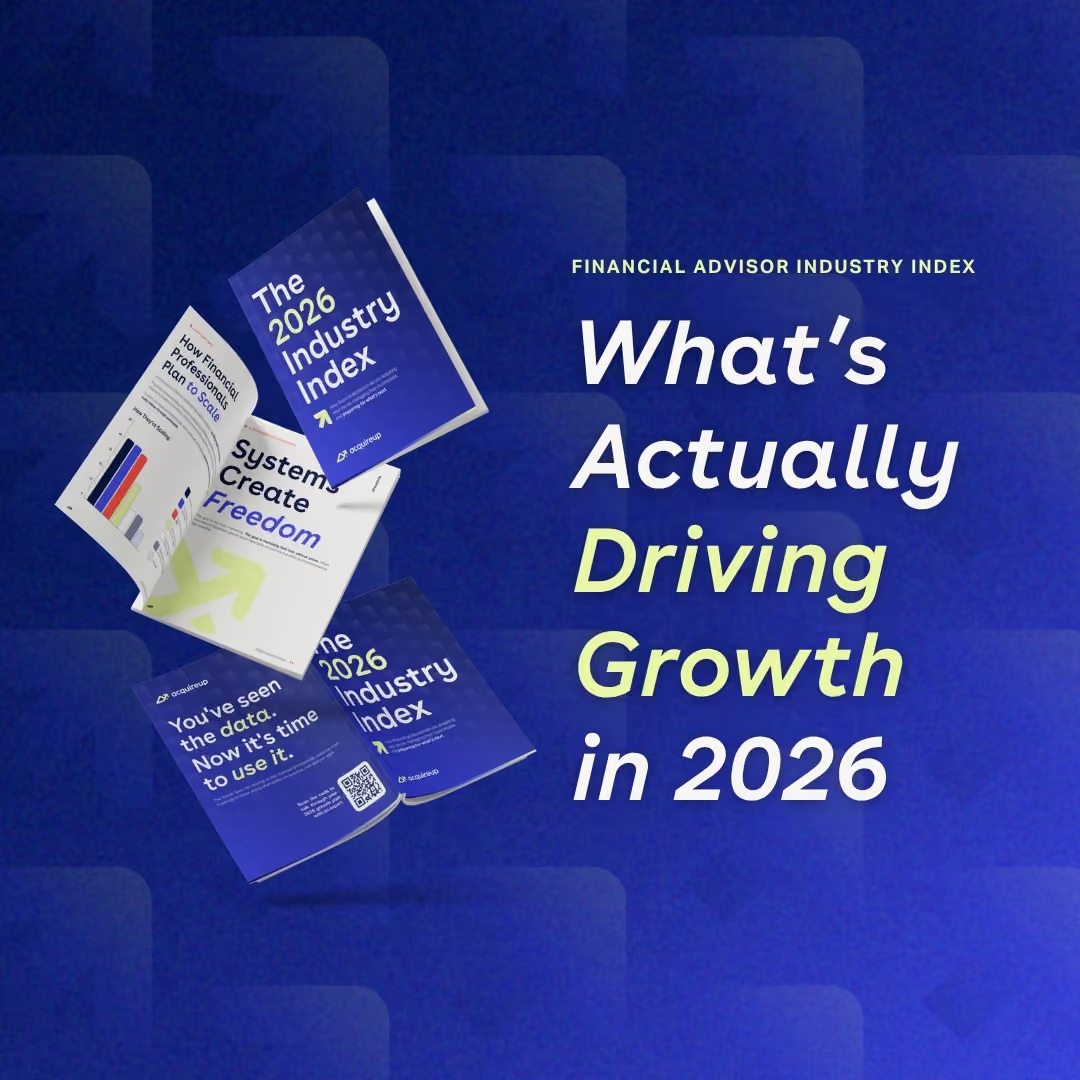
The 2026 Industry Index surveyed 500+ financial professionals on client acquisition, AI adoption, referrals, seminars, and scaling. See what the data reveals and what's separating advisors who grow predictably from those who don't.
Most financial advisors aren't struggling to identify what works. The bigger challenge is turning what works into something that runs consistently month after month, without relying on memory, timing, or manual effort.
That's the central tension the 2026 Industry Index captures, and it's exactly why this report matters.
Built from insights gathered from over 500 financial professionals across firm sizes, specialties, and regions, the Index doesn't just track trends. It shows where growth is actually happening, where execution is breaking down, and what separates advisors who grow predictably from those stuck in a cycle of one-off wins.
What Is the 2026 Industry Index?
The 2026 Industry Index is a research report grounded in real survey data from more than 500 financial professionals—solo practitioners to mid-sized firms, across demographics, specialties, and geographies. Nearly 74% of respondents have been in the profession eight years or more, which means the insights reflect a market that's experienced and execution-focused, not theoretical.
The Index captures how advisors are acquiring new clients, running their operations, adopting technology, and responding to shifting client expectations. It's paired with benchmark data from Track That Advisor to show not just what advisors intend to do, but what's actually producing results in the field.
For financial advisors, that means a real benchmark—not industry noise, not vendor spin—for pressure-testing your strategy and identifying the moves most worth systematizing.
Why the 2026 Industry Index Matters Right Now
If 2025 was about adaptation, 2026 is about operationalization. The advisors gaining ground aren't doing wildly different things. They're building cleaner pipelines, tighter follow-up systems, and more intentional processes around the strategies that already earn trust.
A few headline signals from the data:
- 61% say acquiring new clients is their greatest net new asset growth opportunity
- 48% say networking and referrals deliver the highest ROI, yet 52% have no formal referral program in place
- 57% use AI tools occasionally or frequently
- 34% now conduct more than half their business virtually
- 52% host seminars or workshops as part of their lead generation strategy
- Combined, educational and meal-based seminars account for 25% of total benchmark production
The gap between what advisors know works and what they've actually systematized is where most of the opportunity lives in 2026.
How the Index Works as a Growth Tool: Step by Step
Step One: Get a real benchmark, fast
The Index gives you a snapshot of what peers are prioritizing, from client acquisition strategy to tech adoption to event execution. It's the kind of grounding that's hard to get from conferences or vendor conversations alone.
Step Two: Spot the gap between strategy and system
One of the clearest themes across the data is this: advisors know what works, but many haven't built systems that make it repeatable. Referrals are the most consistent example. They deliver the highest ROI of any channel surveyed, yet more than half of respondents say they're still managing referrals informally. No ask framework. No follow-up cadence. No way to track who sends introductions or what happens next.
That's not a referral problem. That's an execution problem. And it's one of the simplest, highest-leverage opportunities in the entire report.
Step Three: Use the chapter breakdown to make focused upgrades
The Index is organized around the key levers that drive growth: client acquisition, CRM and systems, targeting and segmentation, digital visibility, client relationship management, AI adoption, events, and scaling strategy. That structure makes it easy to isolate one area, benchmark it against the data, and improve it without trying to overhaul everything at once.
Step Four: Apply a "system first" lens
The strongest signal across the 2026 data is this: advisors are moving from experimentation to engineering. Not more tactics. Better pipelines. The winners aren't doing more. They're doing what works, more consistently, with fewer gaps in the process.
What the Data Reveals About Growth in 2026
Trust-based channels still dominate, but they need structure
Referrals, networking, and existing client relationships lead production across the board. Benchmark data from Track That Advisor shows existing clients accounting for 35% of production, referrals and COIs at 15%. These numbers confirm what most advisors already know: growth is built on relationships.
But relationships don't scale on goodwill alone. The advisors pulling ahead are the ones building formal processes around the channels that earn trust like structured referral asks, documented follow-up sequences, and CRM workflows that ensure no introduction gets dropped. When every lead source lands in one place with a consistent next step, growth becomes easier to repeat next month.
AI is entering daily workflow with caution built in
AI adoption is no longer niche. In the survey, 40% say they're somewhat familiar with AI and use it occasionally, while 17% report using it frequently. The most common use cases are marketing (53%) and client communication (49%). This work supports both growth and retention without replacing the advisor at the center of the relationship.
The caution is real too. Accuracy (65%), compliance (55%), and privacy (51%) are the top concerns shaping how AI gets used. That's not resistance, it's judgment. The financial professionals winning with AI are using it to remove repeatable busywork and create more time for the conversations that actually build trust.
The industry isn't going virtual. It's going hybrid
34% of respondents now conduct more than half of their business virtually, and the majority conduct at least a quarter of their meetings online. But the data doesn't suggest a wholesale shift away from in-person. It suggests integration.
Virtual creates efficiency and expands reach. In-person—particularly face-to-face education—remains one of the strongest trust-builders in the field. The advisors who are winning aren't choosing between the two. They're using both with intention, letting each format do what it does best.
Scaling is getting more disciplined
Over the next three years, 66% of respondents plan to grow their client base. And the strategies they're betting on tell a clear story: 41% plan to scale by automating processes, 41% by focusing on high-net-worth clients, and 40% by expanding marketing efforts. Hiring more staff ranks lower.
The implication is significant. Growth in 2026 isn't about adding headcount or complexity. It's about building systems that create leverage so the business can grow without breaking.
Example: How Advisors Use the Index in Practice
In practice, an advisor might read the Index and realize they've been running their referral channel entirely on instinct—no ask framework, no tracking, no follow-up system. They use the benchmark data to build a simple referral process, pair it with tighter CRM workflows, and set a consistent follow-up cadence for every introduction.
Then, as they audit the rest of their growth mix against the data, they notice something: the advisors generating the most consistent production aren't just doing referrals well. They're combining trust-based channels with structured, repeatable events and the numbers behind that combination are hard to ignore.
What the Strongest Growth Strategies Have in Common
Here's what the 2026 data keeps pointing back to: the advisors with the most consistent results aren't discovering new channels. They're systematizing the ones already built on trust—and they're using events as the mechanism that makes those systems work at scale.
Benchmark data from Track That Advisor shows educational and meal-based seminars combined account for 25% of total production. That's not a fringe result. That's a primary driver and one that most advisors are significantly underutilizing.
Only 21% use seminars as a primary marketing strategy. And among those who do host events, nearly half say they do so rarely. That gap is the missed opportunity.
Because seminars aren't just another channel. They create something most marketing tactics can't: a room full of qualified, self-selected prospects, a shared moment of education, and a natural entry point into the follow-up conversation. When 38–42% of attendees go on to schedule a first appointment, and average case sizes run between $692K and $743K per household, the math on consistent seminar execution is compelling.
The data from AcquireUp-powered campaigns reinforces this further. Across core retirement topics—Estate Planning (40% of registrations), Social Security (39%), and Taxes in Retirement (32%)—attendance rates hold near 43%. Nearly half of all registrants report $500K or more in investable assets, and nearly one in three brings $1M or more. These aren't cold leads. They're pre-educated, pre-qualified prospects who showed up because the topic matched their life stage.
And importantly, seminars don't compete with the other channels in your mix. They strengthen them. Digital builds familiarity before the event. Direct mail creates a clear moment of action. The event delivers education in an environment where trust forms faster than any digital touchpoint can replicate. The follow-up system becomes cleaner because the prospect already knows who you are and why they're talking to you.
That's why the advisors generating the most consistent net new asset growth aren't treating events as a one-off tactic. They're treating seminars as the engine—the place where visibility converts to conversation, and where repeatable growth actually gets built.
Here's What Matters
The 2026 Industry Index is valuable because it captures what financial professionals are doing right now and where the biggest execution gaps still exist. But the most important thing it reveals isn't a trend. It's a pattern.
The advisors gaining ground in 2026 are the ones who stopped experimenting and started engineering. They picked the channels built on trust, built systems around them, and created a repeatable process for turning qualified interest into new client relationships. For many of the most consistent growers in the data, seminars sit at the center of that process, not as one tactic among many, but as the structured, scalable environment where everything else comes together.
Your Move
If you want the full breakdown, chapter-by-chapter benchmarks, conversion data, AI adoption insights, and the seminar performance metrics that show what's possible at scale, download the 2026 Industry Index and see how your approach stacks up.



.png)
.avif)